

GBx Co-Chair Alastair Paterson on his $160M exit, and starting over with Harmonic
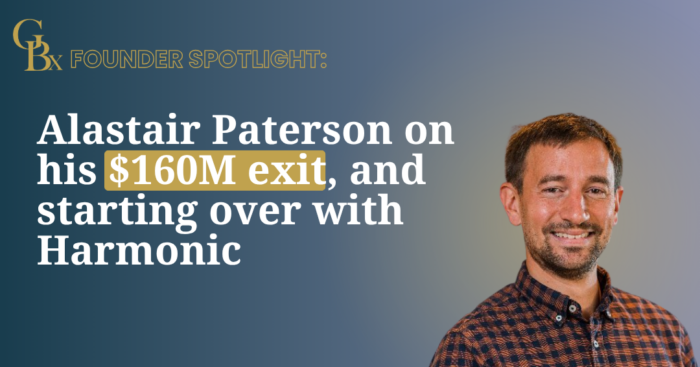
Alastair Paterson co-founded Digital Shadows in 2011, scaled it to 500 customers across four continents, and sold it for $160 million in 2022. But this isn’t a story about a founder riding into the sunset after a successful exit. Alastair did the opposite and put himself back in the founder seat, building Harmonic Security. He is also the driving force behind the UK Cyber Flywheel and has recently been appointed as Co-Chair of the GBx Board. In this GBx Founder Spotlight, he shares what keeps driving him forward and why British founders need to move more quickly.
Not many people build a company from zero to acquisition. Fewer still walk away from a successful exit and willingly start the clock again and build from scratch. Alastair Paterson is one of them.
Alastair co-founded Digital Shadows in 2011 and led it to become an internationally recognised leader in threat intelligence and digital risk protection, before its acquisition by ReliaQuest for $160 million in July 2022. He took a breath, briefly, and then did it all again, building Harmonic Security, enabling enterprises to adopt generative AI without putting their sensitive data at risk.
Alastair is based in San Francisco, where he moved in 2015 and has remained ever since. He now brings that hard-won experience back to the GBx community in his new role as Co-Chair of the Board, with a clear agenda: he wants more British cyber founders to stop waiting, get on a plane, and compete globally.
We had the pleasure of sitting down with Alastair to learn more about his journey to date and the biggest lessons he’s learned from building two category-defining companies.
If I weren’t a founder, I would be…
‘Still building things. I’ve always loved building. As a teenager, I wanted to go into video games; that’s actually what got me into tech in the first place. Maybe I could have done that in another life.
And now, as a dad with two young kids, I spend a lot of time reading them stories. So, a children’s book author would honestly be on the list too.’
The one piece of advice I keep coming back to is…
‘Two things, actually, and they’re both almost embarrassingly simple, but I think about them almost every week.
The first is focus, focus, focus. It’s such an obvious truism, but it matters in almost every situation.
The second, I love because it sounds absurd until you realise it’s true: there are only two types of problems. There are people problems, and there are problems you haven’t yet figured out that are people problems.’
One thing about entrepreneurship that people often underestimate is…
‘When you’re running a company, it feels like you’re getting punched in the face every day, and then you have to come back and tell everyone how great everything is.
It’s a grind. People see the highlights reel: the announcements, the milestones, the polished LinkedIn version, but most of the job is pretty tough. You’ve got to be relentless, deal with the ups and downs, and people rarely talk about those publicly.’
One tool I couldn’t live without is…
‘My answer has completely changed in the last few months. I’m absolutely addicted to Claude Cowork. It’s become my thinking companion and automation tool. If I’m not in a meeting, there’s a good chance I’m doing something in Cowork: analysing customer data, automating parts of my workflow, thinking through future direction. The range of things you can do with it is extraordinary, and we’re still right at the start of this wave, I think, even with all the hype.’
You co-founded Digital Shadows in 2011. What made you take the leap into entrepreneurship to begin with?
‘I’d always thought having my own company would be interesting, and it had been at the back of my mind for a while. After over 6 years at Detica, mostly on the Product side of the house, the company was acquired by BAE Systems. I realised fairly quickly that I didn’t want to be part of a huge defence contractor for the long haul.
The timing also made sense in terms of what was happening in the world. The cloud had appeared, and mobile and social media all arrived in roughly the same window. Companies were suddenly having to navigate completely new technologies, and the digital boundaries that had been solid were dissolving. More and more information was getting out onto the internet in ways organisations hadn’t anticipated. That was the starting point, this concept of the digital shadow, the bits that end up on the internet that maybe you didn’t want there.
I had some very smart colleagues at Detica who were also keen on doing something new. We went from there and had a really good eleven-year journey all the way through to the acquisition in 2022.’
Looking back on your journey with Digital Shadows, what are some of the moments that stand out to you?
‘There are so many moments, but I think the most magical one is having that concept for a solution and discovering that people will actually pay money for it. That’s when it becomes real. You’ve created something from nothing, and there’s enough value there to sustain a business.
I remember we had been doing constant check-in calls with our early customers, as the product was still in its early days. Then we signed a big deal with a major US company, and we asked when they wanted to check-in next. And they said: “Why? This works. What are you talking about?” It was a small moment, but it was a signal that we were out of the design phase. They’d just bought it and were using it.
The other big milestone was coming to the US. We raised a significant round in 2015, I got on a plane, moved my whole life to the Bay Area, and I’ve been here ever since. Setting up the team, opening an office, and figuring out how to do business in a completely different market, it was a wild few years. We ended up with around 500 customers, the majority in the US, and offices in the Bay Area, Dallas, Singapore, Australia, and Germany.’
Reflecting on that journey a bit more, would you do anything differently if you started over?
‘I have very few regrets about things in life generally, and I think you need that mindset to do this kind of job. I’m pretty kind to my prior self: you did what you could with what you had at the time.
That said, in hindsight, Digital Shadows could have probably been ten times bigger if I knew what I know now. But you can’t shortcut the learning. You have to go on those journeys to earn it.
One thing I do think about is that it was actually a blessing that I didn’t raise a huge amount of money on day one. If I’d raised £10 million early on, we’d have burned through it before the customers were ready. We existed on very little for those initial years, which gave us time to really understand the market, just as it came alive.
In that situation, being a first-time founder with low burn and a long runway was actually exactly what was needed.’
After all that success, blood, sweat and tears, you went back and did it all again. What drove the decision to jump back into the founder seat?
‘Genuinely, at the point of the acquisition, I had no plans to start another company. I thought I needed to rest and figure out what was next. But it didn’t take long before I had the itch to build again.
Digital Shadows felt like my training. It took eleven years, but I came out of it feeling like I’d actually qualified as someone who understood how to build and run companies, and I was desperate to apply all of that learning somewhere new.
Then, ChatGPT came out in November 2022, which was four months after the acquisition, and I got completely blown away by it. I was already in the Bay Area, surrounded by people doing interesting things with AI, and the ideas started coming quickly. Some of the team from the previous company were already asking what I was doing next, and then the opportunity to start Harmonic crystallised.
The AI era is the biggest shift I’ve ever seen in enterprise. The question we’re trying to answer at Harmonic is: How do you enable enterprises to take advantage of it safely? Most of what’s slowing adoption is security, legal, and compliance concerns. If we can solve those, we can help companies actually move with AI rather than being blocked by it. That is existential for most companies right now.’
What’s one thing about building a category-leading business that almost nobody tells first-time founders?
‘Understanding your buyer really deeply and empathising with the problem they’re trying to solve. That has to be right at the top.
There are so many founders building technically impressive things, but somewhere they’re missing the fact that you need a customer with a really urgent, important problem. And founders often get fooled early on, because people are quite nice to you at the seed stage. Particularly, British people tend to be encouraging rather than brutal. But that kindness can actually mislead you. You’ve got to find the people who will give you harsh feedback, and develop a skill for drawing it out of them and ask: Would you actually spend money on this?
In cybersecurity specifically, security teams might have 500 things they could address, but realistically, they’re going to prioritise two or three key initiatives a year. You’ve got to be one of those two or three, or there’s no point. Finding that big enough pain point is where I see the most mistakes being made.’
You’ve said UK startups often wait too long to move into the US. What’s your advice to founders thinking about making that move?
‘If you truly want to win a global category, you’ve almost certainly got to win the US market, and it’s very hard to win the US without being there as a founder. The way US institutions buy, the way they think, the fact that they’re generally earlier adopters, it’s different, and you need to understand it from the inside.
What I’ve seen happen, and it happened to me too, initially, is that technically brilliant British founders build great products, get traction, but stay focused on the UK market for too long. The example I always use is Israel. They don’t have much of a domestic market, so they just get on the plane. Founders come over quickly, build out the team, and keep the engineering talent back home. That’s a smart model.
If you’re only working in the UK market for your first couple of years, by the time you land in the US, there are established competitors, domestic players, and companies from other markets already there. You don’t have to move the whole team immediately, but if winning the category is the ambition, you need to start going-to-market in the US quickly.’
As if building Harmonic isn’t keeping you busy enough, you also started the UK Cyber Flywheel initiative. Where did the idea come from?
‘Honestly, it was purely out of frustration and years of conversations over drinks at events with founders, CISOs and VCs, where all of us agreed that the UK wasn’t doing a very good job of helping itself.
The contrast with Israel in cybersecurity is stark: Over the last five years, Israel has produced 50+ exits above $100 million, and the UK has had 5, one of them being Digital Shadows. The frustrating thing is that the people in the UK ecosystem are genuinely great. The talent and ambition are there, but the community is less cohesive, and they’re not supporting each other to the same degree.
The Flywheel concept is about getting the whole ecosystem moving together: Exited founders helping the next wave, CISOs being open to design partnerships with early-stage companies, VCs funding both sides, and the government setting the right conditions. We ran a couple of really successful events, but the goal is simple: instead of five exits above $100 million in five years, the UK should be doing 50+.’
Switching gears slightly, you’ve recently been appointed as Co-Chair of the GBx Board. What has GBx meant to your own journey, and what drew you to the role as Co-Chair?
‘When I arrived in San Francisco, I knew nobody. I got off the plane and had to figure out everything from scratch, including how to set up an office, hire people, and navigate all the genuinely arcane parts of the US system. GBx had just started to exist at that point, and it was a really good group of people genuinely trying to help each other.
What it’s become since then is something quite rare, a high-calibre community where people make real friendships but also help each other operationally. Introductions, hiring connections, sales support, and practical advice on everything from visas to market entry. A real landing pad for British founders coming over here. The idea that I could contribute to that as Co-Chair and help the next wave make it in the US, that was an obvious and easy yes for me.’
Finally, who in your journey deserves more credit than they’ve received?
My technical co-founder, Bryan Woolgar-O’Neil, and the broader team, particularly the people who’ve come across from the Digital Shadows days to join Harmonic. I tend to be the one who does interviews and gets the attention as the CEO, but the people making it actually happen are back at base, grinding away. That’s the real talent, and the superpower of the business.’
Alastair Paterson is Co-Founder and CEO of Harmonic Security and Co-Chair of the GBx Board. He previously co-founded Digital Shadows, acquired by ReliaQuest for $160 million in 2022.
By Hannah Holland