

From Cambridge to Silicon Valley: Ronjon Nag OBE on Building, Investing and Reinventing Yourself
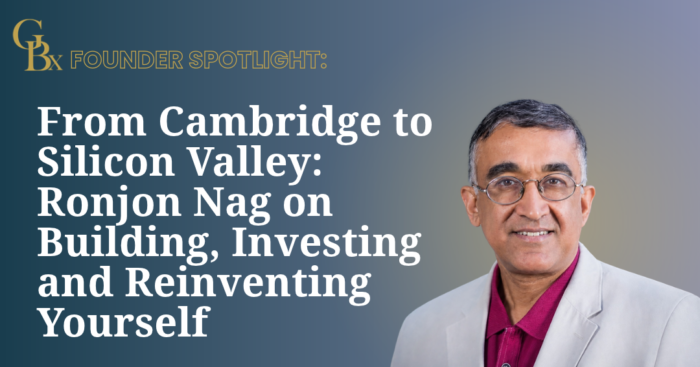
When Ronjon Nag was a child, he wanted to be an astronaut. Decades later, he still does.
It’s a fitting ambition for someone whose career has consistently been defined by moonshot thinking. Long before AI became the defining technology of our era, Ronjon was building speech recognition systems, researching neural networks and exploring how machines might begin to understand the world.
Over the past four decades, he has founded multiple companies (with exits to Apple, Motorola and Blackberry), taught at Stanford, invested in more than 100 businesses and built a career spanning the UK and Silicon Valley. More recently, he was awarded an OBE for services to entrepreneurship and artificial intelligence.
Today, through the R42 Group, Ronjon combines venture investing, education and invention, continuing to work on ambitious ideas ranging from AI-powered drug discovery to ageing vaccines.
We caught up with Ronjon for this GBx Founder Spotlight to discuss physical AI, founder resilience, the surprising similarities between a PhD and entrepreneurship, and why every British founder should spend time in Silicon Valley.
If I weren’t a founder, I would be…
An astronaut.
When I was a little boy, all I wanted to do was become an astronaut. I still do, actually.
Space travel is becoming more accessible and, over the next decade, it will become even more realistic. Beyond the experience itself, I think it fundamentally changes your perspective. Seeing the world from a completely different vantage point changes the way you think about humanity and your place within it.
I like doing new things, and becoming an astronaut would certainly qualify as one of them.
The one piece of advice I keep coming back to is…
Show up. Show up to everything.
We’re living in an increasingly interdisciplinary world, and you never know where your next great idea will come from. It could come from a historian, an archaeologist or someone working in a completely different field.
If you’re a founder, by definition you’re trying to create something that other people aren’t doing. That means you need to seek ideas wherever you can find them.
Get out of your comfort zone. Put yourself out there. Even something as simple as posting on LinkedIn more often can make a difference. People need to know who you are.
One thing about entrepreneurship that people often underestimate is…
It’s very, very hard work. It’s also incredibly lonely.
People often think they’ll build a company in a couple of years and move on, but that’s rarely how it works. Most of the time, entrepreneurship is a game of stamina.
You’re often simply outlasting competitors and sceptics while waiting for the market to catch up to what you’re building.
Most of my companies have fallen into that category. People didn’t necessarily understand what we were building at the time, but years later they would say, “Of course I want one of those.”
My first company took 20 months. My second took 10 years. Another took almost a decade. Founding isn’t quick, so build something you’re genuinely interested in and be prepared to stay the course.
One tool I couldn’t live without is…
Claude.
I use it for everything from brainstorming to presentations and writing. I’ve even configured it to send me daily reminders and prompts for book chapters I’m working on.
Most of the time, I don’t use AI to replace my thinking. I use it as a collaborator. I’ll ask questions, challenge ideas and use it as a thought partner.
That’s become an incredibly valuable part of my day-to-day workflow.
You’ve built companies, invested in founders and taught at Stanford. Which role has taught you the most about entrepreneurship?
My PhD, without question.
People don’t realise how entrepreneurial a PhD programme actually is. You’re expected to do something nobody else in the world has done before. You have to make an original contribution to knowledge.
It’s also incredibly lonely. There’s no syllabus, no predefined roadmap and no obvious answer.
In many ways, a PhD is even more individual than building a company because the final result belongs entirely to you.
I didn’t realise it at the time, but looking back, my PhD was probably my first entrepreneurial experience.
You’ve worked in AI for decades. What excites you most about where the industry is heading next?
Physical AI.
Right now, we’re primarily interacting with digital AI. We ask questions, collaborate with language models and use AI to generate information.
The next step is moving beyond digital systems into the physical world.
People often say that certain professions, such as plumbers or welders, can’t be replaced because they require physical dexterity. But what happens when robots can manipulate the physical world with the same precision as humans?
Imagine restaurants staffed by robots, AI systems carrying out scientific research independently or machines performing highly skilled physical tasks.
Those ideas might sound like science fiction today, but many of the technologies we now take for granted once sounded impossible too.
What do British founders need to understand before expanding to the US?
Don’t hire a representative and stay at home. One of the founders needs to move.
Too many British companies try to expand into the US by hiring a salesperson or opening a small office. That rarely works.
One founder should stay in the UK and the other should relocate to Silicon Valley. You need to become part of the ecosystem and build relationships locally.
You also need to think of yourself as an American company.
The US is the world’s largest homogeneous market, and British founders already have one major advantage: they speak the language.
And Americans love British accents. They make you sound more intelligent than you probably are.
What inspired you to create the R42 Group?
After building companies, I wasn’t entirely sure what I wanted to do next.
Stanford has a programme that allows people later in their careers to return to university and study alongside much younger students. I decided to go back and immerse myself in medicine and human biology. Eventually, I became a professor in genetics.
That experience changed the way I thought about the next stage of my career.
If you’re going to live to 100, why spend your next 30 years doing exactly the same thing you did during the previous 30?
R42 became a way of bringing together all the different parts of my professional life: investing, teaching and inventing.
They’re all interconnected. If I have an idea for a company, I already have a venture fund to support it. If I need talented people, I have access to researchers and students from around the world.
Everything feeds into everything else.
You were recently awarded an OBE for services to entrepreneurship and AI. What did that recognition mean to you?
It was completely unexpected.
I received a call from the British ambassador telling me I’d been awarded an OBE and that it was top secret.
I wasn’t even entirely convinced it was real at first. I thought one of my friends might be playing a prank on me.
I ended up keeping it a secret until it was officially announced.
The award recognised both my work in entrepreneurship and my contributions to artificial intelligence, a field I’ve been working in since the early 1980s.
Back then, almost nobody believed neural networks would become the foundation of modern AI. Today, they’re at the centre of one of the most important technological revolutions in history.
What are you working on now ?
Looking back, I’ve always tried to do what people thought was impossible – from speech recognition, to putting a million features on a phone, or talking in plain language to a device.
Now I’m working on a vaccine that stops you getting 300 age-related diseases. A bodacious goal of course, but I think we can do it, by combining over 1,000 peptides calculated with AI to retrain the immune system to protect the body without going overboard and harming it. I’m doing this with my company, Agemica.com, which is based half in Palo Alto and half in the UK.
Such problems are complex to solve, so to do this, I have been building an AI life scientist, a system where scientists can collaborate with an AI system to create drugs, treatments and research new ideas. We think it will allow even high school students to make contributions to real science. This is with a company called Superbio.ai which now offers gene sequencing for all as well.
Another problem I am working on is age-related macular degeneration, an eye disease that appears for some people as they age. There is no cure for this, and we at Ikshana Therapeutics are working on a gene therapy to cure it in a single treatment at a doctor’s office.
I teach the AI Longevity Lab courses at Stanford, which anyone can take either online or in-person. We also have the R42 Institute where we educate people in AI and work on cutting edge ideas. This summer we trained real biological neurons to do handwriting recognition at one thousandth the energy of semiconductors. Finally, I have just started the R42 Podcast.
Ronjon Nag OBE is Founder and President of the R42 Group, a Stanford lecturer, inventor and investor whose career has spanned artificial intelligence, venture capital, healthcare and entrepreneurship. Over four decades, he has founded and invested in more than 100 companies while continuing to pursue ambitious, interdisciplinary ideas at the frontier of science and technology.