

Founder turned VC, Ali Mitchell: “Our Series B Was the Day We Lost”
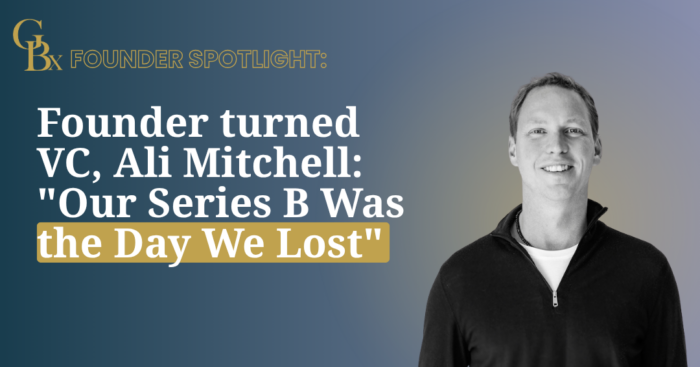
Alastair (Ali) Mitchell co-founded Huddle, one of the original London SaaS success stories, and spent a decade in Silicon Valley. He has since backed some of the most ambitious European founders as a partner at EQT Ventures. Now Managing Partner at his own firm, Odyssey Ventures, he joined us in this interview to share one clear message: if you want to win in the US, stop hesitating.
Ali Mitchell has lived the US expansion story from various angles. He co-founded Huddle in 2006, raised $89 million and scaled its user base to serve 80% of the Fortune 500 and FTSE 100 before its acquisition by Ideagen. He spent a decade in San Francisco, first as a founder navigating the US market, then as partner and co-head of EQT Ventures backing the next wave of European companies going global.
He now leads Odyssey Ventures, the firm he co-founded with Michelle Robson, which launched with a $75 million debut fund focused on helping ambitious early-stage European founders scale into the US alongside investing large late-stage tickets in select growth and pre-IPO global AI winners.
Ali was one of the very first speakers in our GBx Coming to America fireside chat series, which focuses on sharing the learnings from British founders and investors who have made it in the US.
Today, he joins us to share some of the lessons he’s learned, including what he got wrong on his journey to date…
In your opinion, when should a UK founder seriously consider moving to the US, and when shouldn’t they?
‘If you’re a UK startup with genuine global ambitions and a TAM big enough to justify serious capital, there is really only one option: go to the US. And if you’re going to the US, then go early. At pre-seed to build connections for raising your Series A in the US.
The reason is simple. The sooner you get into the US capital flow and become a US company, the sooner you’re seen as a local business rather than a tourist. That makes it easier for investors to back you. That way, you’ll get into the best Series A firms, and you start to build the social, customer, investor and talent references that matter when you go to raise a big Series B. Your network will compound over time.
There’s a phrase I use that might be a little controversial: American investors love European immigrants, but they don’t really like Europeans.
Real or not, they associate European companies with being slow, bureaucratic, and rooted in the home country. Immigrants are different. They’ve uprooted their lives to be there, and they’re all in. That shows complete dedication to the mission.
That said, there are two important caveats to keep in mind. First, this only applies if you’re genuinely aiming to build a global category. There are many sectors and companies for which staying in Europe is exactly the right ambition. The second is timing. Only go if you can go early, and become the global winner from the US. (vs being the European winner trying to crack the US later) My first business, Huddle, is a case in point. We tried to go to the US at Series B, and we should have either gone much earlier, at Series A, competing head-on with big players, or stayed in Europe and won that market properly, then treated the US like a late-stage regional sales office. Instead, we went in the middle and got it wrong on every front.
There are really only two options. You either go very early or you wait and go much later, but never go in the middle.’
What are the biggest misconceptions founders have about competing in the US?
‘There are usually two big ones I see.
The first is underestimating how big and aggressive that market actually is. Going to the US doesn’t mean going to one very concentrated local market. The Bay Area alone is like launching into an entirely new country the size of the UK. You go in full force, or you don’t go at all. That’s why city-by-city focus matters so much in B2B. You’re not targeting the US, you’re going after San Francisco first.
The second is about sales. There’s a common assumption that because Americans are great at sales, you hire a US GTM Leader and they’ll figure it out for you. That’s wrong. US sales leaders are exceptional at taking a proven playbook and executing it at pace and scale. What they won’t do is figure out product-market fit from scratch. That’s the founder’s job. Once you have a repeatable playbook, that’s when you hand it to a US sales leader and let them scale it.’
If you were building for global scale from day one today, what would you do differently?
‘I’d be much more clear-eyed, much earlier, about what type of business I was actually building.
If you’re building a European business, one that wins in Europe, builds a strong position, and ultimately gets acquired by a US competitor, that’s actually a faster, potentially more lucrative and less risky path. But if that’s the case, you don’t want to touch the US too early. You’ll want to focus on winning Europe and treat the US the way US companies treat Europe: a sales market you enter late, with a regional leader, not a full operation.
Or are you actually building something that could win the US and go global? If that’s what you’re after, you need to do it from day one. Be in the market pre-seed, building connections and raising your Series A in the US. But to do that, you have to be ruthlessly honest with yourself. If there are already four or five well-funded businesses doing what you do in the US, don’t go. You’ve lost before you started. No US investor will back the sixth version of something when they’ve got better, bigger and faster options on their doorstep.
The hardest thing is not the decision itself, it’s being honest enough to make it clearly, after considering all your options.’
Is there a particularly career-defining moment you look back on?
‘I don’t think I’ve had one defining moment, but more like twenty micro-careers, failing at most of them and picking up small wins along the way that compound over time. Every time you take a big swing, whether it’s your first startup out of university or a major fundraise, it shapes everything that comes next, even if it doesn’t feel like it at the time.
The Series B at Huddle was a defining moment, but not in the way you’d expect. It was the day we celebrated a big raise and, in hindsight, also the day we lost. That moment of getting the US expansion wrong is what made me the investor I am today: deeply committed to helping founders not repeat those mistakes, and to help them go big properly.
On the investor side, one investment that stands out to me is Handshake. It’s one of the first deals I did in the US, and they’re now one of the fastest-growing AI data businesses in America. They just crossed $1bn of revenue (I invested when they were at $3m), and I’m still on the board, watching that business grow, and being part of it has been genuinely extraordinary. The other one is Pari – the founder of Flow Engineering – a generational AI startup that is creating Cursor for Hardware. After I first met him at Imperial, it took him more than 5 years to figure out his product market fit, then accelerated from seed to A with Sequoia in SF and likely onto a very big B this year.’
Finally, who has had the biggest influence on your career to date?
‘When I was a founder, my answer was always my grandfather. He was a builder, an engineer in the old sense of the word, back when concrete was the technology of the moment. He built some of the most ambitious structures of his era. That spirit of making things, building things from nothing, shaped how I think.
Now, as an investor, the honest answer is the founders I get to work with. I look at them and think: you are so much better than I ever was. What I bring is the experience of the ups and downs, the pattern recognition from having been through it to see around some corners for them. What they bring is resilience and conviction, intellect, clock-speed, creativity and technical talent that genuinely inspires me. Watching a founder like Garrett at Handshake take a mature business doing $150 million in revenue and pivot it entirely into a new AI-driven market and grow to $1bn in 18 months – that’s not in any textbook. That’s what great founders do. I’m learning from them every day.’
Alastair (Ali) Mitchell is Managing Partner at Odyssey Ventures, the early-stage fund focused on helping ambitious European founders scale into the US. He previously co-founded Huddle and was a Partner at EQT Ventures.
By Hannah Holland