

CuspAI’s Dr Chad Edwards on Building Two Unicorns Before Turning 35
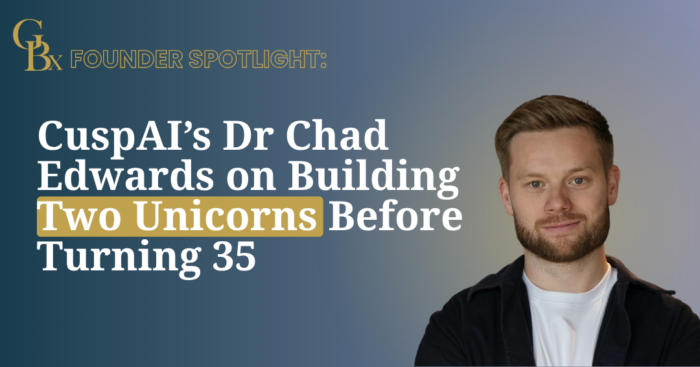
By the time Dr Chad Edwards turned 35, he had helped raise over $1Bn, was well on his way to building two unicorn companies, and had assembled an advisory board that includes two of the most decorated scientists on the planet: Nobel Laureate, Prof. Geoffrey Hinton and Turing Award winner, Prof. Yann LeCun, who are widely credited as the godfathers of AI.
When we asked how he had done it, Chad started with his childhood in a Welsh farming village. Six days a week at 1am, he would hear the rain and wind on the roof and his father driving to the docks in the dark, to collect produce for the family business. Nobody made a fuss of it. It was simply what his father did. Chad has never since been able to shake off that instinct to get up and get on with it.
CuspAI is the clearest expression of that relentless perseverance. One of Europe’s fastest-growing startups — ranked No. 1 on Sifted’s AI 100 list of rising European AI stars — the Cambridge-based company is on a mission to accelerate materials discovery to power human progress. The AI ‘search engine’ for materials has already partnered with Meta on carbon capture, Hyundai on sustainable energy applications, and NASDAQ-listed Kemira on PFAS removal. The company has also turned its attention to semiconductors. CuspAI announced their $100M+ Series A just 15 months after coming out of stealth.
When CuspAI is officially anointed a unicorn (Chad won’t comment on that just yet!), it won’t be his first. As commercial co-founder at Cambridge Quantum Computing, Chad secured its first enterprise customers, including Airbus, BMW, Honeywell and Roche, and in 2021 played a significant role in the merger with Honeywell, which created Quantinuum, now the world’s largest quantum computing company.
For our GBx Founder Spotlight series, we sat down with the serial founder to hear how he approaches building…
If I wasn’t a founder, I would be…
“Building a brewery in the Welsh mountains. I’m a craft beer nerd. That interest has been running in the background through everything I’ve done in the tech world. One day, maybe.”
The one piece of advice I keep coming back to is…
“Adaptation supersedes optimisation. If you think about animals, as soon as the climate shifts, the most adapted species are the ones that fall first. The same is true in startups. If you’re overly optimised for a certain environment and the environment changes, you’re finished. The ability to adapt quickly is far more valuable than being perfectly tuned for one single moment in time.
“I actually apply the same thinking to parenting. I’m never going to be a perfectly optimised parent. These are growing human beings, and I’ve never been a parent before. You figure it out as you go.”
One thing about entrepreneurship that people often underestimate is…
“How much disorder is supposed to exist inside a startup. Startups are inherently bound to dissolve into chaos, that’s just physics. As a founder, your job is to reduce entropy, and that requires a huge amount of sustained energy.
“What people underestimate is how finite that energy is, and how important it is to spend it in the right places. If you focus in the wrong direction, you don’t have enough left to hold things together and the whole thing dissolves. You have to spend your energy on the few things that move the needle. It’s hard.”
Where did the idea for CuspAI come from, and how did you decide that the time was right to make the leap and start the business?
“I’m a trained Chemist and spent my PhD trying to make materials in a lab, before moving into quantum computing, which is a promising future tool to unlock new materials. I spent several years helping grow Cambridge Quantum, from 14 to 550 employees.
“In late 2023, I started seeing signals in technical papers suggesting that machine learning could do something genuinely new in materials discovery. These early signals suggested a path ahead that didn’t need to wait for quantum computing, and wasn’t entirely dependent on lab experiments.
“Everything started converging. I met Prof. Max Welling, who had just stepped away from the AI Science Leadership Team at Microsoft. It turned out that we were both thinking about this opportunity and had arrived at exactly the same thesis, completely independently. A whole generation of interesting companies would be built around these developments. He’s deeply technical, I’m more on the commercial side. It felt like we’d been looking for each other.”
Within months of founding CuspAI, you announced a $30M seed round and a partnership with Meta. What made that possible?
“A few things came together.
“The technological vision was clear; Max and I were among the first to go to market with the view that agents would take over entire scientific workflows. We had a world-class team assembling quickly, and Max’s reputation in the AI world is extraordinary, so we were able to bring Prof. Geoffrey Hinton and Prof. Yann LeCun on board early.
“I also think investors were hearing something different. Back then, most of the time, they saw the latest productivity tool or note-taking app, but we walked in and said: “We want to leave the world better than we found it, and we have the science and the team to start doing that.” That mission, combined with the technology, got people genuinely excited.
“The Meta partnership grew out of that same spirit. They came to us focused on carbon capture, and there was an immediate alignment. Meta actually helped shape our thinking around that problem. They’ve been an incredible partner from almost the beginning.”
If you had to name one achievement you’re most proud of, what would it be and why?
“It’s got to be our team. We have people who are technically exceptional, genuinely among the best in the world at what they do. But we’ve also built a culture that’s collaborative, open, and very low-ego.
“You have to work with this team every single day, so having people who lift each other up, who bring different perspectives, who don’t let their identity get in the way of the work, that’s the single biggest achievement. Everything else is built on top of it.”
What advice do you have for founders looking to build at scale?
“1. Don’t underestimate your team, it’s the base of everything. A lot of young startups dissolve not because the idea is wrong, but because the dynamics between people break down. You need to get the team and the culture right first.
“2. Pace yourself. This is a long game. Build a culture that lets people have lives, because they do have lives. The whole working 9am to 9pm, six days a week, is something you see celebrated in a lot of tech cultures, but I really don’t believe in it. Companies are built over years, not hours. If you don’t pace yourself and your team, you won’t last.
“3. Lastly, stay focused. When you’re building a company, you have technology, team, fundraising, partnerships, and commercialisation all pulling at you simultaneously. The discipline to keep your energy on the things that actually move the company forward, and not get distracted by everything else, is one of the most underrated skills a founder can have.”
Finally, who in your journey deserves more credit than they’ve received?
“Dr Markus Hoffmann. I first found Markus through LinkedIn, years ago, when I was doing my MBA and looking for an internship. I messaged him just after midnight, and he replied within five minutes. Even though he was in Munich, an hour ahead.
“I ended up doing an internship with him at Google, and we’ve stayed close ever since. He helped me get my next role, helped me identify the startup that became my previous company, and has been a mentor and advisor through everything. He’s been a constant, steady presence. And because I’m quite an impatient person, he’s always been the one to slow me down just slightly, or at least enough to see things more clearly.
Now Markus is our Chief Strategy Officer at CuspAI.”
Dr Chad Edwards is the Co-Founder and CEO of CuspAI, the frontier AI company accelerating materials discovery to power human progress.
By Chiara Benn