

Alice Bentinck MBE on Founder Psychology, AI and Why British Entrepreneurs Should Move to the US Earlier
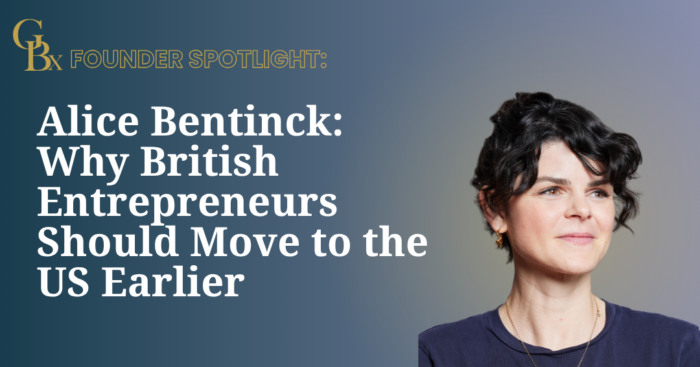
Alice Bentinck has spent more than a decade trying to answer one of technology’s most difficult questions: how do you identify exceptional founders before everyone else does?
As Co-Founder and General Partner at Entrepreneurs First, she’s built a company dedicated to finding ambitious individuals, helping them find co-founders, develop ideas and build globally significant businesses.
Alongside EF, she co-founded Code First Girls, which has taught hundreds of thousands of women to code and become one of the UK’s most influential technology education initiatives.
What hasn’t changed since launching EF in 2011 is the mission: finding and unlocking exceptional entrepreneurial talent. What has changed is how that mission is delivered. Today, every company built through EF is incorporated in the US and relocated to the Bay Area, reflecting Alice’s belief that founders should be immersed in the world’s most ambitious technology ecosystem.
We caught up with Alice for this GBx Founder Spotlight to discuss founder psychology, building in the US, AI, and the qualities that separate exceptional founders from everyone else.
If I weren’t a founder, I would be…
When I was a kid, I was obsessed with animals, so I probably would have been a vet.
The one piece of advice I keep coming back to is…
When I was thinking about becoming a founder, I read about Jeff Bezos’ regret minimisation framework, which is really just a fancy way of saying: do the things you’ll regret not doing later in life.
I still think that’s one of the most useful pieces of advice at every stage of the founding journey. It’s a great reminder to do the right thing and not worry too much about what anyone else thinks.
One thing about entrepreneurship that people often underestimate is…
To some extent, it’s a resilience game, and it doesn’t really get any easier at any particular stage.
One tool I couldn’t live without is…
Right now? ChatGPT.
How has your vision for Entrepreneurs First evolved since launching it in 2011?
I don’t think the vision has evolved, but what we actually do has changed radically.
The vision has always been to find and unlock high-potential founders and give them the right environment to get started: helping them find the right co-founder, develop the right idea and gain access to the best investors.
How we do that has changed enormously. We’ve run EF in seven different countries, the programme itself has evolved significantly, and the biggest shift we’ve made recently is bringing every company we build to the US.
Today, wherever an EF company is founded, it’s incorporated as a Delaware C-corporation and relocated to the Bay Area.
After meeting thousands of founders through EF, what qualities do the very best have in common?
There are the obvious characteristics: challenging convention, ambition, drive and the ability to inspire others.
But there are also some softer traits we pay close attention to. We look at founders’ beliefs about themselves and their beliefs about the world.
Many exceptional founders have an unusually high level of personal exceptionalism. They genuinely believe their odds of success are different from everyone else’s. They can be obsessive, often pursuing multiple interests and ideas simultaneously and fully. Many are deeply interested in influence and impact, what some would call megalomania.
When we’re evaluating founders, we’re not just assessing ability. We’re trying to understand the behaviours they exhibit and the beliefs that drive them.
Where do you think the biggest opportunities in AI lie over the next five years?
The area I’m most interested in right now is AI for consumers.
It’s still unclear exactly how that market will evolve, and there’s renewed interest from younger founders building in this space.
We’re still thinking about AI through the lens of previous generations of software, and I think that’s limiting. I’m particularly interested in founders who want to explore entirely new models for consumer AI.
Alongside EF, you co-founded Code First Girls to help more women build careers in technology. What progress are you most encouraged by, and what still needs to change?
Code First Girls has now taught hundreds of thousands of women to code for free, and we’ve seen an incredible number transition from non-technical backgrounds into full-time technical careers.
When we first started, we thought it would create more female founders. That hasn’t happened to the extent we’d hoped, which tells me there’s still more work to do.
I do think role models matter. We need to continue showing that entrepreneurship is an incredible career path, regardless of gender.
One thing I’ve noticed is that conversations about women in technology can sometimes become too focused on what’s missing. While those challenges are real, we also need to be careful not to unintentionally send the message that technology and entrepreneurship aren’t welcoming spaces. We need to show that they are.
What advice would you give British entrepreneurs looking to build or scale in the US?
Move here.
Conventional wisdom often suggests waiting until Series A, but I actually think it’s easier to relocate at seed stage. By Series A, your company culture is often firmly rooted in the UK, you’ve built a team there and you’ve accumulated enough infrastructure that moving becomes much more difficult.
At EF, we encourage all of our companies to move to the US at seed stage.
And even if you’re not relocating permanently, I’d encourage both founders and investors to make a quarterly pilgrimage to the Bay Area.
Spend time here. Build your network. Understand how people think. Immerse yourself in the ecosystem.
I’d love to see more British founders and investors investing the time to do exactly that.
Alice Bentinck MBE is Co-Founder and General Partner at Entrepreneurs First and Co-Founder of Code First Girls. Through EF, she has spent more than a decade identifying and backing exceptional founders, helping build companies that now span the UK, Europe, Asia and the United States.